
Dealing With Grumpy, Complaining, Critical, or Difficult People
Dealing with Grumpy, Complaining, Critical or Difficult People. It seems that holidays bring out both the best and worst in people. P.T. Forsyth said, “You must live with people to know their problems, and live with God in order to solve them.” The classic churchman, C.H. Spurgeon noted — “Get a friend to tell you your faults, or better still, welcome an enemy who will watch you keenly and sting you savagely. What a blessing such an irritating critic will be to a wise man, what an intolerable nuisance to a fool!”
Having been a pastor for over forty years, and a church health consultant for over twenty of those years, I have seen my share of such people. There have been a number of writers and psychologists and behavior academics who have written on this subject. Business and church leaders can tune in podcasts or zoom classes on how to deal with difficult people in the workplace or the church, or even in your extended family unit. Marshall Shelley in 1985 wrote a book on Well-Intentioned Dragons: Ministering to Problem People in the Church (Bethany House). Steven Covey in his 7 Habits of Highly Effective People (Simon/Shuster) talks about the different paradigms of human interaction, and Tom Whiteman in his The Complete Stress Management Workbook (Zondervan) gives stress management techniques in dealing with such people. This blog borrows from these and other sources.
How do we deal with grumpy, complaining, critical or difficult people? Such people, and Shelley calls them "dragons," are usually familiar, even family people, who are highly resistant to your ideas but also highly committed to what they believe is true and just. There are truly evil people, really bad people, who talk and act like people possessed by evil motives and inflict harm on others. We are not talking about such people here. Rather, our subjects are often well-intentioned and well-meaning people, but difficult. They exist in all quarters of society, including and notably in churches. In fact, because of our sinful natures, we can all become such people, were it not for the grace of God and the restraining forces of others and providence around us.
I believe God places such people in our paths to mature and sanctify us if we are believers personally and professionally. Peter Marshall has said — “It is a fact of Christian experience that life is a series of troughs and peaks. In his efforts to get permanent possession of a soul, God relies on the troughs more than the peaks. And some of his special favorites have gone through longer and deeper troughs than anyone else.”
Most difficult people are either eventually winnable, or their negative effects can be neutralized in time. “The goal in handling dragons is not to destroy them, not merely to dissassociate, but to make them disciples. Even when that seems an unlikely prospect.” (Shelley, 34) “Every time we say, ‘I believe in the Holy Spirit,’ we mean that we believe there is a living God able and willing to enter human personality and change it.” (J.B. Phillips) How do we do that?
Understand them! Many of these kind of people are circumstantially difficult. A number have had abusive or very difficult childhoods. They have been deeply hurt or compromised by so-called good people, even church people. They have been through deep valleys and in desperate situations we can hardly believe. They behave the way they do with a skewered and negative view of life and others. Here sympathetic, even empathetic, understanding goes a long way to winning them. Jesus told us that loving others and praying for them not only pleases God the Father, but also gives us a kingdom perspective that helps difficult people.
Other such people are just mean people. I don't buy into a Pollyanna viewpoint that all people are at root "good" people who just need a little love and understanding. No one, in the biblical view of things, is naturally or essentially "good." We are sinners by nature and by choice. Some difficult people are just difficult by their personalities. They are hard to get along with. They see the worst in others and life itself. They are "critical" people [the word Jesus uses here], with logs and self-conceit in their own eyes, as Jesus portrayed them in Matthew 7, perhaps self-righteous and hypocritical, but just hard. I know this because of my father who believed and lived like everyone else had an "agenda" against him. He was an angry man, who liked actually very few people. Most would counsel to avoid such people, if you can.
Inculcate a positive atmosphere, as much as it depends on you. Theologian Reinhold Niebuhr said — “You may be able to compel people to maintain certain minimum standards by stressing duty, but the highest moral and spiritual achievements depend not upon a push but a pull. People must be charmed into righteousness.” Instead of fighting with difficult people, seek to change their atmospheric life with joy, hope and love. Ministers should especially have such an attitude and project that positivity to others, especially those set against them.
Understand, practice, and preach and teach, if you are a Christian, Ephesians 4:15 — “. . . speaking the truth in love, we will in all things grow up into him . . .” “Truthfulness” AND “love” CAN and MUST function together. (cf. Ps. 25:5; 40:11; 85:10; John 1:14; Rom. 12:9a; 1 John 3:18). Verbally speak the truth in an attitude of love and concern for Jesus' sake.
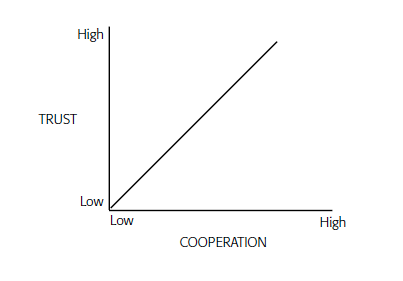
Understand the six (6) paradigms of human interaction (Covey) illustrated in the diagram. The goal is a mutually beneficial, or satisfying, relationship — a "win/win." Such a goal is a synergistic relationship of love and truth, a symbiotic relationship where two dissimilar people live together in a mutually beneficial relationship. "Win/win" is simply, but profoundly, the application of the Golden Rule. Maturity here is really the balance between courage and consideration.


Understand the truth and applicability of “what you SEE is really what you see.” You will often have to RE-FOCUS to deal with difficult people. (Shelley calls this “reframing the dragon.” This doesn’t change the dragon, but it does affect the way we treat them!) If you see people as "problems to solve," that is what they will be to you in your verbal and body language with them. And, if you see people as an "agenda" to conquer or resolve, that will dismiss their humanity as image bearers of God.
Use stress-management techniques to deal with difficult people. Tom Whiteman posits four A's here — Analyze, Accept, Alter, Avoid. ANALYZE the situation and person to see what the wisest course of action should be. ACCEPT the person by an intentional adjustment of attitude toward and with them. Accept any conflict as normal; accept the fact of disagreement without being disagreeable; keep conflicts short and then apply Ephesians 4:26 — "Be angry and do not sin; do not let the sun go down on your anger." ALTER your attitude toward and with the person. See it as healthy; look for a win/win solution; focus on the issue not the person; choose your loses and what you will fight for. AVOID conflict by using good communication practices.